Physical Address
304 North Cardinal St.
Dorchester Center, MA 02124
Physical Address
304 North Cardinal St.
Dorchester Center, MA 02124

Meta Title:
HVO Fuel Explained: Benefits, Uses & Diesel Compatibility
What is HVO Fuel?
HVO fuel (Hydrotreated Vegetable Oil) is a renewable diesel alternative produced from waste oils, vegetable oils, and animal fats through a hydrogen treatment process. The result is a high-quality paraffinic fuel that closely resembles conventional diesel in chemical structure.
Because of this, HVO can be used directly in most diesel engines without modification. This makes it a drop-in fuel, allowing businesses to reduce emissions without changing existing equipment.
As industries face increasing pressure to reduce carbon emissions, HVO has emerged as a practical solution. Unlike many alternative fuels, it does not require major infrastructure changes.
Specially countries which has a big plantation advantage (such Palm ) , they may prefer HVO for natural source advantage.
This is particularly important for sectors where reliability is critical, such as:
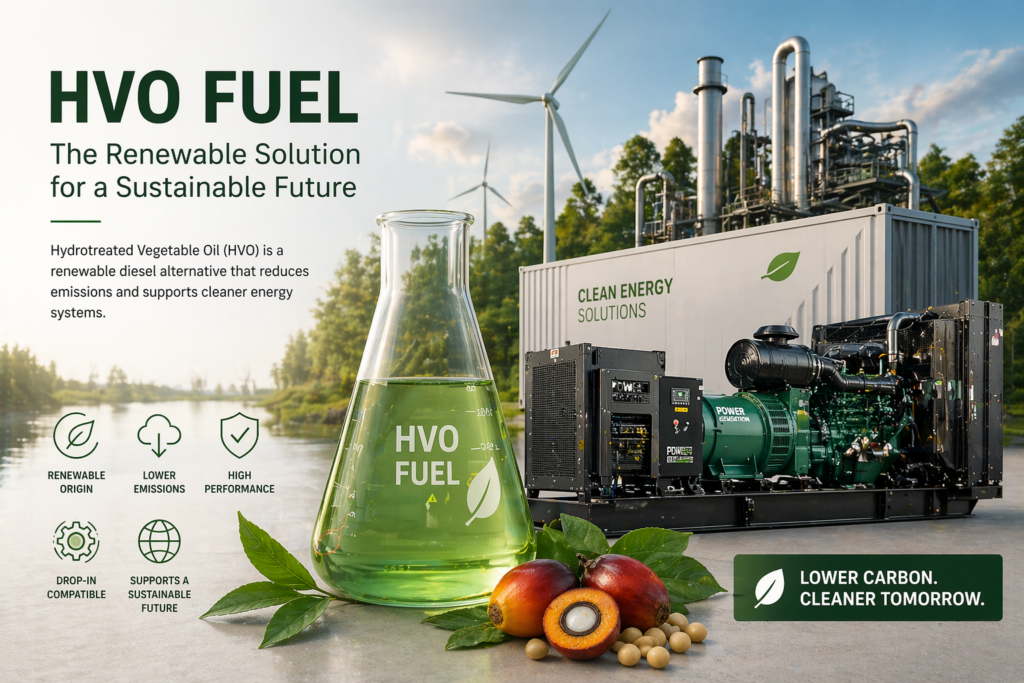
HVO can reduce lifecycle greenhouse gas emissions by up to 90% compared to conventional diesel, depending on feedstock and production method..
One of the biggest advantages of HVO fuel is that it works with:
No engine modifications are typically required.
HVO produces:
This results in a cleaner combustion process and can contribute to lower maintenance needs over time.
Unlike biodiesel, HVO is resistant to oxidation and degradation. This makes it ideal for:
For generator-based systems, especially in data centers, fuel reliability is non-negotiable.
HVO provides:
This allows operators to reduce emissions without compromising uptime or operational stability.
Despite its advantages, HVO also comes with considerations:
As demand grows, supply chain and pricing are expected to evolve.
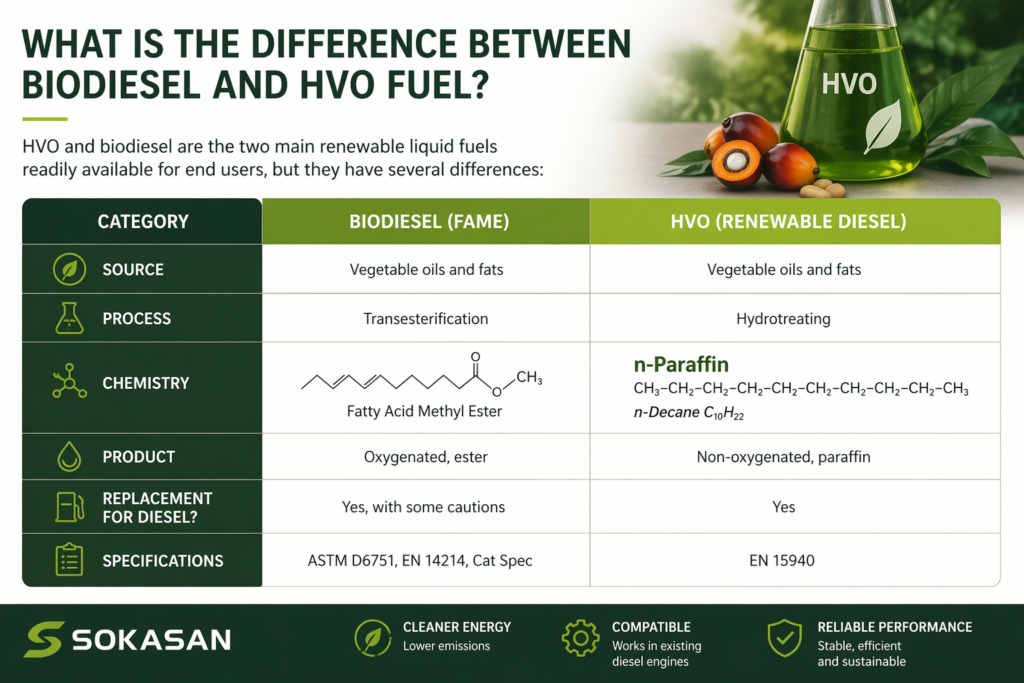
Although both fuels are derived from renewable sources, their properties differ significantly.
HVO is a paraffinic fuel, while biodiesel contains oxygen. This distinction leads to several practical advantages:
These characteristics make HVO more suitable for applications where reliability and fuel quality are critical.
One of the key drivers behind HVO adoption is its ability to reduce greenhouse gas emissions.
Based on lifecycle assessments referenced by Caterpillar, renewable liquid fuels such as HVO can significantly lower net CO₂ emissions compared to conventional diesel, depending on feedstock and production methods.
In real-world applications, this reduction can be substantial—making HVO a practical option for companies aiming to meet sustainability targets without major operational changes.
Fuel storage is a key consideration, especially for backup systems.
HVO’s paraffinic structure provides:
This makes it well-suited for applications where fuel may be stored for extended periods before use.
Despite its advantages, HVO is not without limitations.
The availability of sustainable feedstocks—such as waste oils and fats—can impact production capacity. In addition, supply and pricing may vary depending on regional infrastructure and demand.
As highlighted across industry sources, the long-term scalability of HVO depends on responsible sourcing and continued development of supply chains.
HVO fuel represents a practical and immediate way to reduce emissions while maintaining existing diesel-based systems.
Its ability to combine sustainability with operational reliability makes it particularly valuable in sectors where performance cannot be compromised.
Rather than requiring a complete system overhaul, HVO enables a gradual transition—offering a realistic path toward lower-carbon operations today.
In countries such as Indonesia and Malaysia, HVO is gradually gaining attention across both transportation and power generation sectors. Demand is already starting to emerge, particularly in applications where emission reduction is becoming a priority.
Looking ahead, this demand is expected to grow further as regulatory pressure increases and companies seek more sustainable fuel alternatives without changing existing infrastructure.
At present, one of the main limitations remains production capacity. The availability of sustainable feedstock and the scale of refining processes are still not sufficient to meet large-scale demand.
However, if more efficient and cost-effective production methods are developed, HVO has the potential to expand rapidly. In such a scenario, it could become a strong alternative—and in some cases even replace—biodiesel or conventional diesel in a relatively short time.
You can more about HVO from the below links
https://www.cummins.com/sites/default/files/2023-12/hvo-fuel-faq-2023.pdf
https://www.mtu-solutions.com/eu/en/stories/marine/commercial-vessels/hvo-makes-the-difference.html